Spent outputs in Monero look identical to unspent ones
Chain analysis cannot distinguish them
Privacy by default, not by opt-in
Sign in for your own network · People picked by Mostard
Schmidt reposted

The xmr(.)fan times, Issue No. 6 is out!
https://xmr.fan/news
You can read it in 6 languages, or listen the podcast in English or Spanish.
Schmidt reacted 👍
The xmr(.)fan times, Issue No. 6 is out!
https://xmr.fan/news
You can read it in 6 languages, or listen the podcast in English or Spanish.

GM 🫡
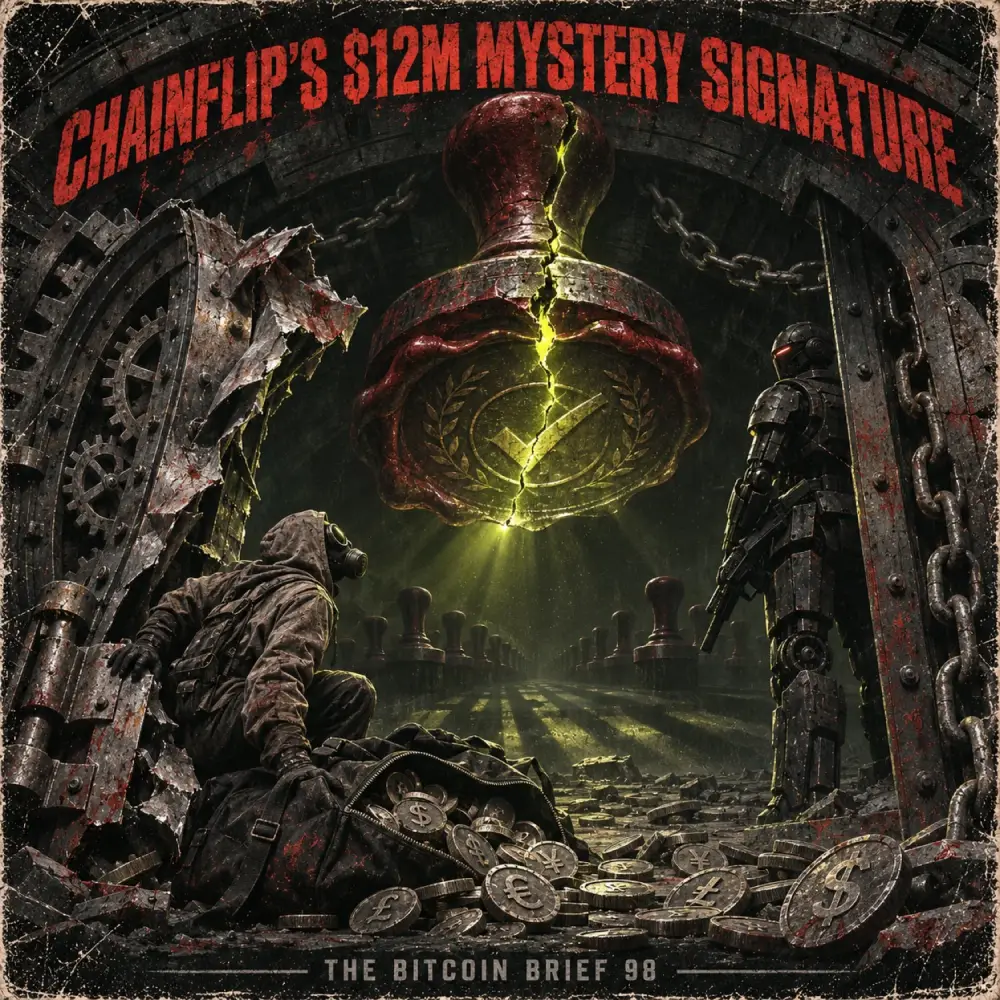
Chainflip's $12M swap drain had a valid signature from its vault, the kind that needs 100 of 150 validators. The attacker bought a seat and joined the set.
Yesterday's Bitcoin Brief has that plus the Binance hack coins turning up in coinjoin, and the Tor fingerprinting bug Passport Core just fixed.
Listen: https://fountain.fm/episode/tqyjIXoTuZVVReuVB5bt
Show notes: https://ungovernable.network/shows/bitcoin-brief/chainflip-s-12m-mystery-signature/

New 3D games for TUI people..
Another really important point that I hadn't appreciated at first: the description in the paper does not discuss the possibility of the encryptor being dishonest. So if they encrypt garbage, the decryptor, who has a valid ZKP, still can't get the money out. The way this is addressed in BABE is with a cut and choose of a garbled circuit, but that's done in a very specific way to keep the size down. I don't think you could do that here (if you tried i think it would be way too big)? Maybe a ZKP but i'm really not certain if that's possible either.
Thoughts on Praxis https://eprint.iacr.org/2026/2971
(One of the authors, David Tse, also wrote BABE). It's the natural extension of the same goal as BABE, but with different crypto. That's not to underplay it: it's a truly groundbreaking result assuming nothing is fundamentally wrong. This is *general* witness encryption at a ciphertext size of 8GB, cf OOM 100TB (maybe a lot less? they're working on it) that the alloc-init team proposed in PIPEsv2 (btw that paper was posted around the same time as BABE).
Remember: BABE was proposed to do one specific thing: allow a party to unlock a utxo and claim its bitcoin if they had a valid ZKP. That's an extraordinary thing to be able to do, but it's still limited to just "claim this one utxo" because bitcoin does not have covenants, you can either spend or you cannot. With BABE, the nice part was that what the decryptor has to store is just 240MB-ish (it's actually 22MB per garbled circuit but you need a bunch of them for reasons I won't go into). One can't argue whether that's practical, it clearly is. 8GB is more arguable; depends how you're using it. But the bad part of BABE was that it required a setup between the "encrypting party" and the future decrypting party - the one that at some point in the future will have a ZKP that authorizes them to take the coins. So it didn't have that very nice property a lot of people were looking for : any party can take the coins if they present authorization, not only someone defined in advance.
Praxis takes away that last restriction; *anyone* can take the coins, if they have a valid ZKP. But it doesn't do two other crucial things:
1 - you still need to define the set of entities that can make a withdrawal at the time of setup (the time you deposit the coin). this is a huge restriction, but IMO it's necessary if you want the rules to be coherent. To explain: suppose Alice is the one depositing the coin and setting up the witness encryption. Then she knows the secret, that anyone else needs a ZKP to get. That means, if the utxo is unlocked *only* by that secret, she can take it any time, *without* a valid witness (without the right to withdraw according to the rules). The only way to prevent that is to define the set of withdrawing parties at the start, and lock to their keys.
2 - the fact that bitcoin doesn't have covenants means this is a pure 'take the whole utxo, or take nothing' situation, if done in 'raw' form. Encryptor pays to a utxo locked by a secret. With covenant emulation though, which can be a signing committee and a 1 of n honesty assumption, you can set up a pre-signed transaction tree to extract a portion of the amount, with bit decomposition, as we do in Lichen. 1 of n signing committees have not proven to be that easy to set up in real life, but there's no doubt it's a possible way for things to work.
Lichen addresses these problems by making everything a bilateral contract. Presigning is intrinsic, the payout counterparty is defined upfront. Swapping out BABE for Praxis looks possible but currently not practical at 8GB per user ciphertext vs 240MB total in BABE (if it was like 10x smaller it'd probably be the better option, as it takes out a lot of setup and interaction, the encryptor just literally gives the file to the future prover and that's it).

No intellect could assemble a child and make it work. It was an entirely different kind of artificer that was at work inside her, an order of intellect that dwarfed the one in her mind

https://media.monostr.com/1b0372e37925ed4124fe0e7581cb195e490a33ce41c1cf18c1b62429ed8b9fdd.jpg